
Are you hesitating about wearing barefoot shoes in the city? It’s no wonder, as the information on this topic is often contradictory. Experts and laypeople are divided into two camps – some recommend barefoot shoes for city use (often citing their own experiences), while others claim that wearing barefoot shoes in the city is harmful to your feet (and warn about the health risks of hard, flat surfaces).
In this article, we present the opinions of both sides. Despite their opposing statements, both share the same goal – to provide yourself and your children with city shoes that protect the feet from unwanted injuries. We join this effort as well, which is why we’ve explored the topic of barefoot shoes in the city in depth, to debunk some of the myths circulating online…
Frequently Asked Questions
- Do I need shoes with a thick sole for the city?
- Will wearing barefoot shoes in the city hurt my feet?
- Does an artificial surface prevent healthy walking?
- Is it worth wearing insoles in barefoot shoes in the city?
- Are there barefoot shoes with a thicker sole?
- Are barefoot shoes suitable for the city?
- Barefoot shoes in the city – yes or no?
1. Do I need shoes with a thick sole for the city?
When you walk correctly (see the next point), you can wear soles as thin as you like. In fact, a thin and flat sole is more beneficial because it allows your foot to respond better to changes in surface and improves overall stability.
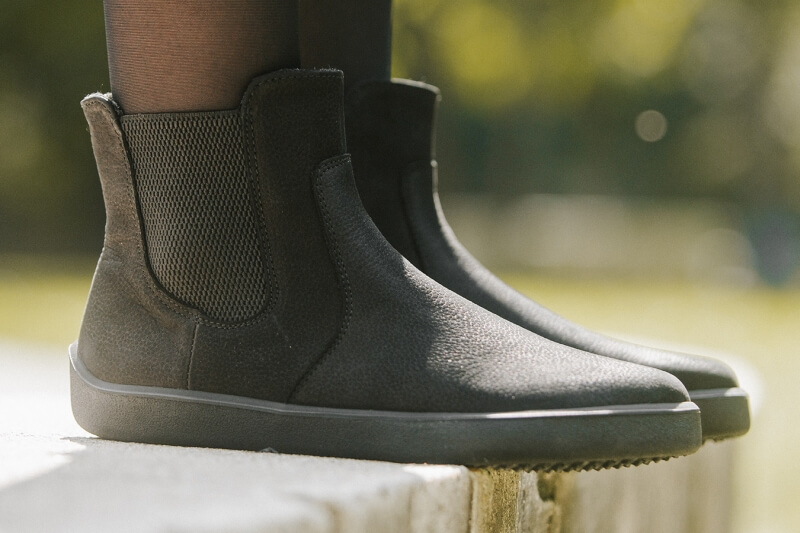
Physiotherapist Iva Bílková describes the difference between walking barefoot, in regular shoes, and in barefoot footwear: “The Achilles tendon functions as a shock absorber during impact and also helps accelerate the body against gravity. In a regular shoe, the cushioning function is in the sole, whereas a barefoot shoe essentially has no shock absorber.”
2. Will wearing barefoot shoes in the city hurt my feet?
Barefoot shoes teach proper walking technique the hard way — you either start stepping the way nature intended, or walking on hard surfaces will hurt (and you’ll be asking for trouble). The rule is simple: don’t rush and don’t stomp — walk as if you were truly barefoot. Once you master that, there’s no risk of injury. Most people (especially children) learn this naturally; the rest can benefit from consulting an expert.
The problem, therefore, doesn’t lie in barefoot shoes themselves, nor in the city’s hard surfaces, but in unhealthy walking habits most people have. “How will our feet react if we’ve always worn firm shoes with cushioning and suddenly switch to barefoot in everyday life? Our gait will remain the same — with the same heel strike and the same push-off,” points out Marie Součková, a member of the Medical Podiatric Center in Prague.
Physiotherapist Michael Tichov compares the actual impact on joints when walking: “Barefoot shoes help align the body and make people stop walking on their heels, which means their joints won’t suffer from shocks. If you wear regular shoes and walk around the city at a faster pace, those shocks are much greater.”
“Walking in barefoot shoes is not suitable for diabetics or for people with more serious neurological or orthopedic conditions. For milder musculoskeletal issues, the suitability of barefoot footwear should be assessed individually,” adds physiotherapist Blanka Černá, highlighting the risk groups for whom barefoot shoes could do more harm than good.
3. Does an artificial surface prevent healthy walking?
“If we walk barefoot on a hard, flat surface, the forefoot becomes abnormally overloaded, and the ligaments and tendons that shape it become fatigued. I definitely recommend and praise barefoot walking or wearing barefoot shoes — but on uneven terrain,” points out orthopedist Ondřej Rejda. However, an ordinary city is far from being as flat as a skating rink.
“It’s good to remember that even though hard surfaces dominate in cities, they’re still uneven. You step on curbs, cobblestones, or tactile paving for the visually impaired, and so on. What’s truly unsuitable is spending several hours walking around a shopping mall — smooth, hard floors like that really make your feet suffer,” clarifies physiotherapist Soňa Barvenčíková.

“Take off your shoes and walk barefoot through the city. You’ll see that almost nowhere is the surface flat and uniform,” confirms physiotherapist Zuzana Kejíková. “Those who are used to walking barefoot can even use walking on asphalt as a form of training. The less natural the environment, the more it can strengthen and activate us. The essential condition, however, is the correct walking technique,” adds physiotherapist Lukáš Klimpera for inspiration.
4. Is it worth wearing insoles in barefoot shoes in the city?
For those who find the soles of barefoot shoes too thin, it’s easy to add an extra layer in the form of insoles. On the other hand, this partially reduces the sensitivity of the foot’s sole to surface feedback, so it really comes down to personal preference.
According to Michael Tichov, there’s nothing wrong with adding an orthopedic insole with arch support to barefoot shoes if you need some support — your feet can still strengthen thanks to the shoe’s design. Orthopedist Agnes Adamová adds that barefoot shoes can be perfectly combined with custom-made insoles designed to keep the foot in the correct position.
5. Are there barefoot shoes with a thicker sole?
Yes, so-called “compromise shoes” retain the advantages of barefoot footwear (a wide toe box, soft and flat sole) but have a thicker sole that provides better shock absorption. They’re especially suitable for adults who are just starting out with barefoot shoes. The most popular brand in this category is Anatomic.
6. Are barefoot shoes suitable for the city?
Some people imagine “barefoot shoes” as five-toed monsters or handmade sandals they’d be embarrassed to wear in the city. But the days of those early barefoot experiments are long gone — today’s barefoot shoes rival conventional footwear in appearance. You can now find plenty of stylish barefoot shoes for the city that you’ll be proud to wear anywhere.
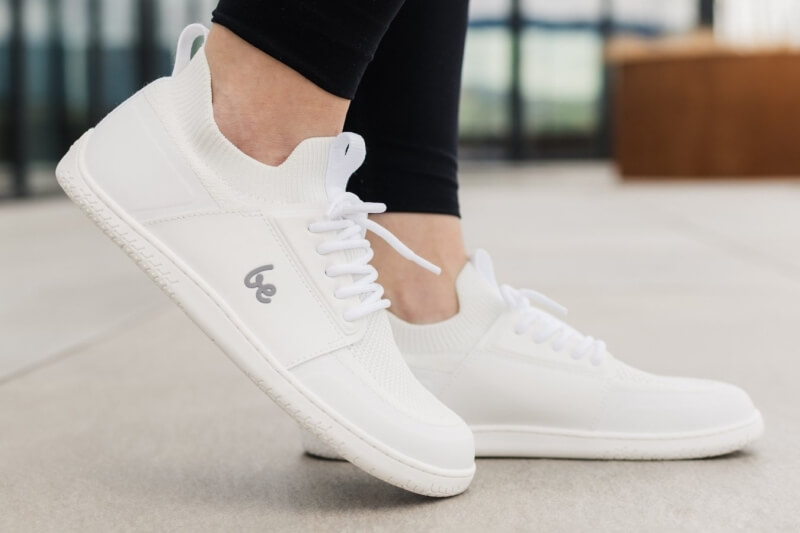
7. Barefoot shoes in the city – yes or no?
Yes—but only if you don’t stomp on your heels while walking. We’ve covered countless kilometers in barefoot shoes around the city without a single problem. However, rushing is a mistake—your feet will quickly let you know they’re unhappy with careless walking. Similar experiences are shared on forums by users who have already tried wearing barefoot shoes in the city themselves:
- "I’ve been wearing barefoot shoes for many years, but for fast walking in the city, I couldn’t tolerate the thinnest soles — when you stomp, it’s not pleasant at all."
- "I wear barefoot shoes everywhere. I simply had to learn to walk properly. My husband wears them too, but sometimes he’s careless with his walking, so in the fall he wears compromise shoes."
- "I wear them in the city because of the shape of the toe box, and I add an extra insole. On their own, they wouldn’t be comfortable for me."
- "For example, I walk all day (10 km every day) in Merrell with thin soles or Camper (summer and winter). I’m not exactly slim, and I walk normally around the city."
Try barefoot shoes for the city